
Table of Contents
- What Advanced Movement Screening Reveals About Athletic Performance
- The Seven Fundamental Movement Patterns and What They Show
- Identifying Asymmetries, Imbalances, and Compensatory Patterns
- Biomechanical Assessment for Athletes: From Screening to Action
- Corrective Exercise Programming Based on Movement Deficits
- Injury Prevention Screening Protocols for Your Sport
- Integrating Movement Screening Into Your Training Plan
- Frequently Asked Questions
Last Updated: September 18, 2026
What Advanced Movement Screening Reveals About Athletic Performance
Advanced movement screening for athletes goes far beyond a simple flexibility test or range-of-motion check. It’s a systematic assessment that exposes how your body actually moves under load, reveals asymmetries that predict injury, and identifies the specific motor control deficits holding back your performance. At Neuromuscular Strategies, we use movement screening to build a precise map of your movement quality and guide targeted corrective work. (Source: National Institutes of Health (NIH) study on sports injuries)
The real power of advanced movement screening lies in what it reveals about the relationship between mobility, stability, and motor control. Many athletes move through their sport with compensatory patterns they don’t even know exist. A pitcher might achieve full shoulder range of motion but lack the neuromuscular control to stabilize that motion under rotational load. A cyclist might have excellent hip mobility but poor glute activation, forcing the lower back to compensate on every pedal stroke. Movement screening catches these disconnects before they become injuries.
The best time to screen is before pain shows up. Athletes who screen proactively and address deficits early typically return to sport faster if injury does occur, because the neuromuscular foundation is already strengthened.
The Seven Fundamental Movement Patterns and What They Show
Functional movement assessment focuses on seven core patterns that appear in virtually every sport: the squat, lunge, push, pull, hinge, rotation, and carry. Each pattern tests a different combination of mobility, stability, and motor control across multiple planes of motion.
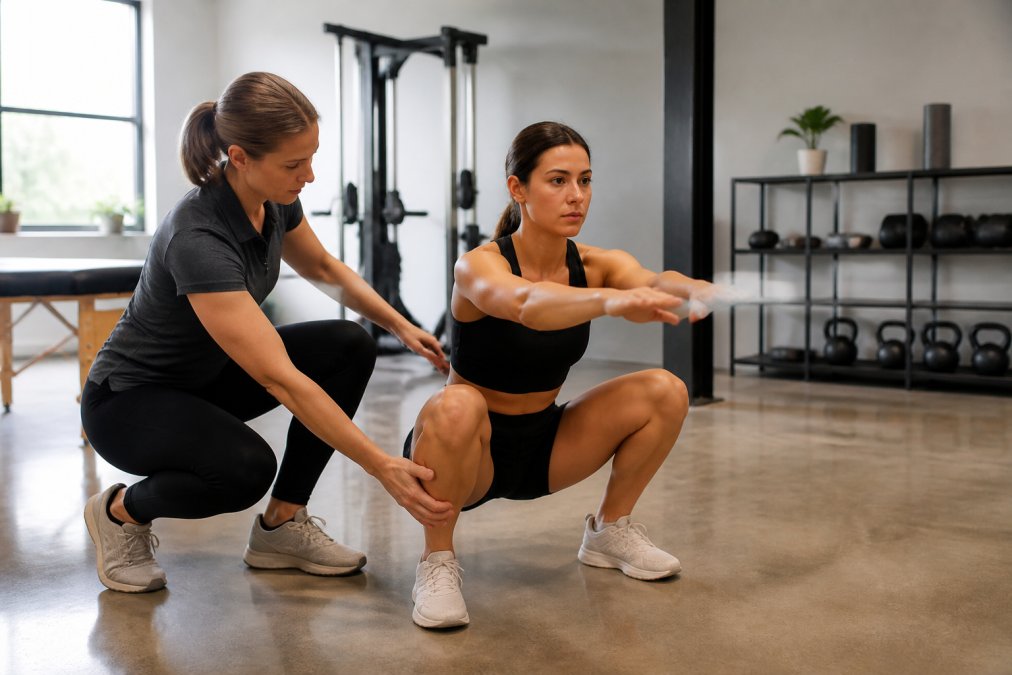
The squat pattern reveals hip mobility, ankle dorsiflexion, knee tracking, and core stability in the sagittal plane. Poor squat mechanics often signal limited ankle mobility or weak glute activation. The lunge tests single-leg stability, hip flexor length, and the ability to maintain postural alignment under asymmetrical load. The push and pull patterns assess shoulder stability and scapular control, critical for overhead athletes and anyone managing shoulder pain. The hinge pattern isolates hip extension strength and spinal stability in flexion. Rotation tests transverse plane control and the integrity of your kinetic chain. The carry, simply walking while holding weight, exposes postural alignment, core endurance, and whether one side of your body compensates for the other.
What makes these patterns valuable is that they’re sport-specific enough to matter but universal enough to apply across athletes. A runner’s lunge reveals different information than a baseball player’s lunge, but both reveal stability and motor control deficits that predict injury risk.
Identifying Asymmetries, Imbalances, and Compensatory Patterns
Asymmetry is the signature of injury risk. When one side of your body performs differently than the other, whether in strength, range of motion, or motor control, your nervous system defaults to compensation. Over time, compensation becomes injury.
Advanced movement screening quantifies asymmetry. A side-to-side comparison during single-leg balance, single-leg squat depth, or rotational reach reveals which side is lagging. The key insight: asymmetry doesn’t mean you’re broken. It means your nervous system has learned an uneven movement strategy, usually because of past injury, overuse, or simply sport-specific demands. Runners develop asymmetrical hip strength. Overhead athletes develop asymmetrical shoulder mobility. These patterns are predictable and correctable.
Compensatory patterns are the hidden cost of asymmetry. If your left hip is less stable, your right hip works harder. If your right shoulder lacks mobility, your left shoulder compensates with excessive motion. If your core isn’t providing stability, your lower back takes the load. Movement screening makes these patterns visible. You’ll see a client shift their weight to one leg during a squat, hike their hip during a single-leg stance, or rotate excessively through their spine instead of their hips. Each compensation tells a story about which system, mobility, stability, or motor control, is failing.
Ignoring compensatory patterns is the fastest path to chronic injury. The body adapts to compensation, making it harder to correct later. Address deficits early through targeted corrective exercise.
Biomechanical Assessment for Athletes: From Screening to Action
Biomechanical assessment translates movement patterns into actionable data. It’s not enough to identify that an athlete has poor single-leg stability. You need to know why: Is it ankle proprioception? Hip abductor weakness? Lack of motor control? Core engagement? The answer determines your corrective strategy.
The real value isn’t the technology, it’s the interpretation and decision-making framework. A physical therapist or strength coach observes movement quality during standardized tests, identifies specific deficits in mobility or stability, then tests motor control under progressively challenging conditions. For example, if an athlete scores a 2 on the squat pattern due to forward knee drift, the assessment continues: Does ankle dorsiflexion improve when the feet are wider? Does the drift disappear with external cueing? Does glute activation improve with a resistance band around the knees? Each question narrows the root cause.
The assessment-to-action pipeline follows a logical sequence: (1) Observe movement quality during standardized tests and record scores. (2) Identify the specific system failing, mobility (joint range of motion), stability (muscular control of that range), or motor control (nervous system coordination). (3) Test that system in isolation and under load. (4) Prescribe corrective exercise matched to the specific deficit. An athlete with poor hip external rotation needs different corrective work than an athlete with poor glute activation, even if both present with knee pain. This targeted approach is far more effective than generic “prehab” routines.
When reassessing, use the same protocol and environment each time. Rescreen every 8-12 weeks. A meaningful improvement is typically a noticeable improvement in movement quality or asymmetry metrics. If progress stalls, the corrective strategy likely needs adjustment, either the exercise isn’t addressing the root cause, or the athlete needs a higher challenge level.
Corrective Exercise Programming Based on Movement Deficits
Corrective exercise programming is where movement screening becomes performance enhancement. Once you’ve identified the specific mobility, stability, or motor control deficits limiting an athlete, you design a progression that addresses the root cause.
Schedule a Free 15′ Consultation call →
Corrective exercise programming follows a predictable sequence: restore mobility in restricted joints, activate and strengthen underactive muscles, then integrate the corrected pattern into sport-specific movement. A runner with limited ankle dorsiflexion starts with ankle mobility work, progresses to glute strengthening in dorsiflexion, then integrates the pattern into running drills. A baseball player with poor scapular stability starts with shoulder blade activation, progresses to rotational strength, then integrates the pattern into throwing mechanics.
The critical principle: corrective exercise must be specific to the deficit and progressive. Generic core work doesn’t fix asymmetrical hip stability. Generic shoulder stretches don’t restore scapular control. The exercise must address the exact system that’s failing, mobility, stability, or motor control, and progress as the athlete adapts.
The best corrective programs are boring. They target one specific deficit, progress methodically, and integrate into sport-specific movement only when the athlete demonstrates control. This is why personalized assessment is essential.
Injury Prevention Screening Protocols for Your Sport
Sport-specific screening protocols recognize that different sports demand different movement qualities. A soccer player’s screening emphasizes lateral stability and rotational control. A swimmer’s screening emphasizes shoulder mobility and scapular stability. A cyclist’s screening emphasizes hip stability and anterior core control. The seven fundamental patterns provide the foundation, but the emphasis changes based on sport demands.
Injury prevention screening also considers the specific injuries common in each sport. A screening protocol for runners should emphasize hip stability and ankle proprioception, the deficits that predict running injury. A screening protocol for overhead athletes should emphasize shoulder mobility and scapular control. A screening protocol for contact athletes should emphasize neck stability and dynamic balance.
The most effective injury prevention protocols combine movement screening with sport-specific demands. A volleyball player might screen well on standard tests but lack the reactive stability needed for rapid changes of direction on court. Sport-specific screening captures these context-dependent deficits that standard tests might miss.
Integrating Movement Screening Into Your Training Plan
Movement screening isn’t a one-time event. It’s a baseline that informs your training strategy and provides a benchmark for progress. The most effective athletes use screening results to guide training focus, prioritize corrective work, and track whether deficits are improving over time, and increasingly, they integrate wearable technology and longitudinal data to monitor movement quality throughout the competitive season.
Integration starts with clarity: what does your screening reveal about your limiting factor? Is it mobility? Stability? Motor control? Once you know, you can prioritize corrective exercise within your existing training. A runner with poor ankle mobility adds ankle mobility work to their warm-up. A lifter with poor scapular control prioritizes scapular activation before pressing movements.
The most effective athletes don’t just get screened once. They establish a baseline, commit to corrective work, reassess progress every 8-12 weeks, and track movement quality throughout their competitive season. This systematic approach prevents injuries before they happen and ensures that your training is building movement quality, not just fitness.
Frequently Asked Questions
How does advanced movement screening differ from basic physical assessments?
Advanced movement screening goes beyond measuring strength or flexibility. It evaluates how your body moves through multiple planes of motion, identifies compensatory patterns, and reveals asymmetries that may not show up in standard tests. Basic assessments often focus on isolated muscle groups, while advanced screening examines how your entire system coordinates during functional, sport-specific movements.
Can movement screening help identify injury risks before they happen?
Yes. Advanced movement screening identifies movement dysfunctions and imbalances that increase injury risk. Reduced mobility in the ankle or hip, poor stability in the core, or asymmetries between sides can signal vulnerability to specific injuries. By detecting these functional deficits early, you can address them through corrective exercise programming before they develop into pain or injury.
How often should athletes undergo movement screening?
Most athletes benefit from comprehensive movement screening before the competitive season begins and again after significant breaks or injuries. For athletes returning to sport after surgery or injury, screening every 2-4 weeks during rehabilitation helps track progress and guides progression. Seasonal athletes should screen at least once yearly; those training year-round or managing chronic pain may benefit from screening every 3-6 months. Your physical therapist can recommend a timeline based on your sport, training volume, and injury history.
What should I expect during a biomechanical assessment?
A thorough biomechanical assessment includes observation of movement quality across sagittal, coronal, and transverse planes; evaluation of joint range of motion and proprioception; testing of dynamic balance and stability; and sport-specific movement patterns. Your therapist will assess postural alignment, identify compensatory patterns, and evaluate how well your kinetic chain coordinates. The assessment helps identify movement deficits, asymmetries, and can inform customized exercise recommendations tailored to your sport and goals.