
Table of Contents
- Understanding Chronic Back Pain and Physical Therapy’s Role
- Core Strengthening Exercises for Spinal Stability
- Physical Therapy Exercises for Back Pain Recovery
- How Long Does Physical Therapy Take for Back Pain
- Benefits of One-on-One Physical Therapy Sessions
- Conservative Treatment vs. Surgical Options
- Building a Maintenance Plan After Physical Therapy
- Frequently Asked Questions
Last Updated: September 25, 2026
Understanding Chronic Back Pain and Physical Therapy’s Role
Chronic back pain affects millions of people and often persists long after initial injury. At Neuromuscular Strategies, we understand that physical therapy for chronic back pain requires a personalized approach that addresses the root cause, not just the symptoms. Unlike generic stretching routines, effective treatment focuses on restoring spinal stability, improving movement patterns, and rebuilding confidence in your body’s ability to function.
Acute pain is sharp and recent; chronic pain lingers for weeks, months, or years. Rest alone rarely resolves it, your spine needs active rehabilitation to regain strength and mobility.
Physical therapy for chronic back pain works by targeting three key areas:
- Core and deep spinal stabilizer muscles
- Movement patterns and posture
- Pain science education to reduce fear and anxiety
Research shows that conservative treatment, exercise, movement retraining, and education, helps most people avoid surgery and return to activities they enjoy.
Core Strengthening Exercises for Spinal Stability
Spinal stability depends on deep core muscles like your transverse abdominis and multifidus, which act like a natural corset. When these weaken, your spine loses support and pain often returns.
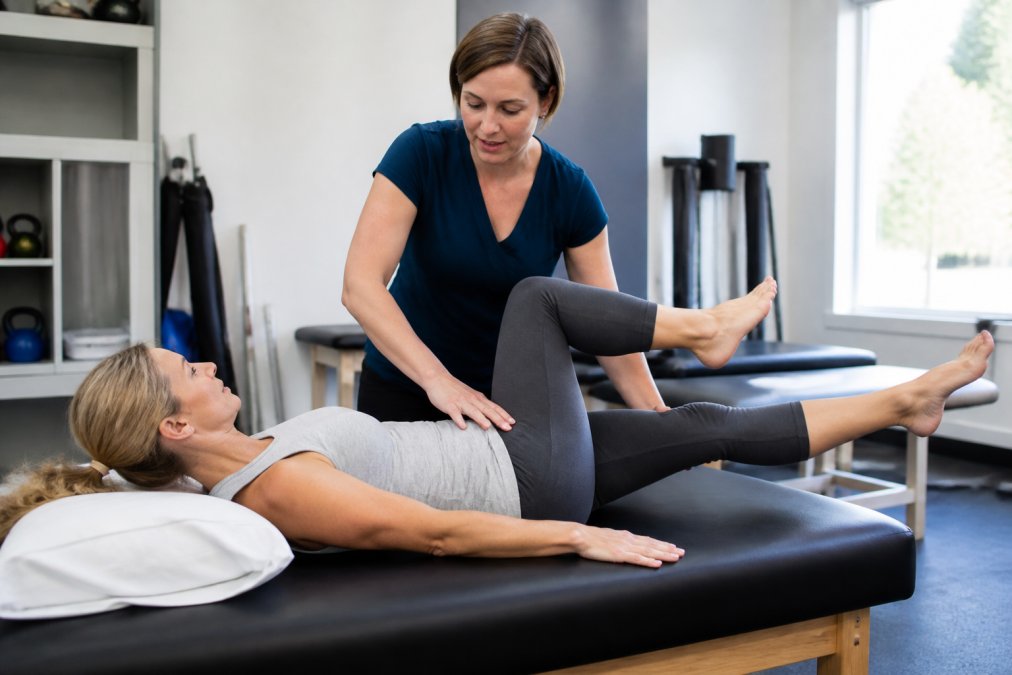
The most effective core exercises build neuromuscular control, your nervous system learns to activate the right muscles at the right time.
Key core exercises include:
- Pelvic tilts: Lie on your back with knees bent. Tilt your pelvis to flatten your lower back against the floor. Hold for 3-5 seconds. Repeat 10-15 times.
- Bird dog exercises: Start on hands and knees. Extend one arm and opposite leg. Hold for 3 seconds. Alternate sides. Do 10 reps per side.
- Dead bug hold: Lie on your back with arms extended toward ceiling. Lift shoulders slightly off floor. Keep lower back pressed down. Hold 10-20 seconds.
- Glute bridges: Lie on your back with knees bent. Push through heels to lift hips. Squeeze glutes at the top. Hold 2 seconds. Do 12-15 reps.
- Quadruped rocking: On hands and knees, rock hips back toward heels while keeping spine neutral. Move slowly and controlled.
Start with 2-3 sets, 4-5 times per week. Quality matters more than quantity.
Many people rush through core work. Slow down. Feel the muscles working. Your brain needs time to reconnect with these stabilizers. This process takes weeks, not days.
Physical Therapy Exercises for Back Pain Recovery
Physical therapy exercises for back pain include flexibility, mobility, and functional movement work. The real power lies in retraining how your nervous system perceives and responds to movement.
Chronic back pain often involves central sensitization, where your nervous system amplifies pain signals even when tissue damage is minimal or healed. Targeted movement exercises send your nervous system a powerful message: “This movement is safe.”
How movement rewires pain perception:
Slow, controlled movements with focused attention engage your prefrontal cortex (thinking brain) rather than your amygdala (alarm brain), shifting you out of protective mode and into learning mode.
Graded movement exposure, gradually expanding your movement repertoire, desensitizes an overprotective nervous system. Your brain needs repeated, safe experiences to update its threat assessment.
Essential flexibility exercises:
- Knee-to-chest stretch: Lie on your back. Pull one knee toward your chest. Hold 20-30 seconds per side. Signals that hip flexion is tolerable.
- Hamstring stretch: Lie on your back. Loop a towel around one foot. Gently pull toward your chest. Hold 20-30 seconds per side. Reduces compensatory lower back strain.
- Spinal twist: Lie on your back with knees bent. Let both knees fall to one side. Hold 20-30 seconds per side. Restores confidence in spinal rotation.
- Cat-cow stretch: On hands and knees, alternate between arching and rounding your back. Do 10-12 reps. Teaches that flexion and extension are both safe.
- Child’s pose: Kneel and sit hips back toward heels with arms extended forward. Hold 30-45 seconds. Signals safety while gently loading the spine.
Mobility work teaches your spine to move safely in all directions through active, controlled motion. Many people with chronic back pain avoid certain motions because their nervous system has flagged them as dangerous.
The goal of physical therapy exercises is not just pain relief, it’s retraining your nervous system to perceive movement as safe and rebuilding your confidence in your body’s ability to function without fear or limitation.
How Long Does Physical Therapy Take for Back Pain
Timelines for improvement vary based on pain severity, duration, and program adherence.
Typical recovery timeline:
- Weeks 1-2: Pain may increase slightly as you begin moving. This is normal. Consistency matters more than intensity.
- Weeks 3-4: You notice small improvements in mobility and daily function.
- Weeks 6-8: Meaningful strength gains appear. Pain begins to decrease noticeably.
- Weeks 9-12: Many individuals report significant improvement and return to preferred activities.
- Weeks 12+: Maintenance phase. Continue exercises to prevent relapse.
Stopping exercises too early is a common mistake. Even after pain improves, your spine still needs strengthening. Many people relapse within weeks of quitting their program.
Benefits of One-on-One Physical Therapy Sessions
One-on-one sessions offer advantages group classes cannot match: a therapist assesses your unique patterns, identifies compensations, and adjusts your program in real time.
Key benefits of one-on-one sessions:
- Direct assessment of your movement patterns and posture
- Real-time correction of exercise form
- Progressive program adjustments as you improve
- Education about how pain works and why movement helps
- Accountability and motivation to stay consistent
- Faster progress toward your specific goals
Conservative Treatment vs. Surgical Options
[Conservative treatment](/blog/) is often effective for chronic back pain. Surgery may be considered as a last resort.
Conservative treatment includes:
- Physical therapy and exercise
- Pain science education
- Postural retraining and ergonomic adjustments
- Complementary approaches like massage, acupuncture, or yoga
- Activity modification and gradual return to function
When surgery may be necessary:
- Severe nerve compression causing weakness or loss of function
- Structural instability that doesn’t respond to therapy
- Progressive neurological symptoms
- Specific conditions like herniated disc with severe radiculopathy
Conservative physical therapy is best for people who want to avoid surgery, prefer a gradual return to activity, and are willing to commit to a consistent exercise program.
Building a Maintenance Plan After Physical Therapy
Recovery doesn’t end when formal therapy ends. Maintaining an exercise routine after formal therapy can help prevent relapse. A structured maintenance plan prevents relapse and keeps your spine strong for life.
The three phases of post-therapy transition:
Phase 1: Supervised Graduation (Weeks 1-4 after discharge)
Phase 2: Independent Management with Periodic Check-ins (Months 2-6)
Your maintenance plan should include:
- Core strengthening: 3-4 times per week
- Flexibility and mobility: 4-5 times per week (10-15 minutes daily is more effective than one long session)
- Postural awareness: Hourly check-ins; vary positions frequently
- Activity progression: Gradually return to sports and hobbies you love
Phase 3: Long-term Prevention (Month 6 onward)
A sustainable long-term plan might look like:
- Core and stability work: 2-3 times per week
- Flexibility and mobility: 3-4 times per week
- Periodic check-ins with your therapist (or as-needed if pain returns)
To overcome this:
-
Reframe the goal: Exercise to maintain strength and prevent relapse, not just reduce pain.
-
Identify warning signs: Stiffness, posture slipping, or movements feeling less confident. Increase exercise frequency immediately when noticed.
-
Build exercise into routine: Anchor exercises to existing habits (after coffee, during news). Habit is stronger than motivation.
-
Track functional progress: How far can you bend? How long can you stand? Can you play with your kids? These matter more than pain scores.
Creating your personalized maintenance menu
For example:
- If your weakness is core stability, your non-negotiables might be: bird dog, dead bug, and glute bridge.
- If your weakness is hip mobility, your non-negotiables might be: 90/90 stretch, pigeon pose, and deep squat holds.
- If your weakness is thoracic rotation, your non-negotiables might be: quadruped rotations, half-kneeling rotations, and cat-cow.
When to seek help again
You don’t need therapy forever, but you should know when to return. Red flags include:
- Pain returning to previous levels
- New pain in a different location
- Loss of function (can’t do activities you could do last month)
- Postural changes you can’t correct
- Persistent stiffness despite consistent exercise
A structured maintenance plan is best for people who want to prevent relapse, understand that recovery is a long-term process, and are willing to commit 30-45 minutes per week to exercises even after pain improves. The investment now prevents months of pain and dysfunction later.
Frequently Asked Questions
How long does it typically take to see results from physical therapy for chronic back pain?
The timeline for noticing improvement varies based on pain severity, injury history, and adherence to exercises. Progress depends on how well you follow your personalized exercise program between sessions and your body’s individual healing response. Your physical therapist will reassess your progress regularly and adjust your treatment plan accordingly.
What are the benefits of one-on-one physical therapy compared to group classes?
One-on-one physical therapy provides customized assessment of your specific movement patterns, spinal alignment, and pain triggers. Your therapist can adjust exercises in real time based on your response, correct form immediately, and address unique biomechanical issues that group settings cannot. Personalized sessions allow for detailed pain science education tailored to your condition, direct feedback on posture and neuromuscular control, and flexible pacing that matches your recovery speed rather than a predetermined class schedule.
Can physical therapy actually help if I’ve had chronic back pain for years?
Yes. Even long-standing chronic back pain responds to evidence-based physical therapy that addresses the root cause rather than just symptoms. Physical therapists use movement screening and functional assessment to identify stability deficits, mobility restrictions, or biomechanical patterns contributing to persistent pain. A whole-person approach combining therapeutic exercise, posture retraining, and pain science education helps your nervous system recalibrate pain perception. Many patients with years of chronic pain achieve meaningful relief and return to activities they thought were lost.
What should I expect during my first physical therapy session for back pain?
Your first session includes a thorough physical assessment: detailed history of your pain, injury, and activities; movement screening to evaluate spinal stability and range of motion; and functional testing to identify movement limitations. Your therapist will explain the likely cause of your pain using pain science concepts, discuss your goals, and design an initial exercise program. Most sessions are 60 minutes, allowing time for assessment, hands-on treatment if needed, exercise instruction, and education. You’ll leave with a clear understanding of your condition and a customized plan to begin.