
Table of Contents
- Why Cyclists in Boulder Need Specialized Physical Therapy
- Common Cycling Overuse Injuries and Their Warning Signs
- How Bike Fit and Physical Therapy Work Together
- Cycling Injury Prevention Exercises That Address Root Causes
- Indoor vs. Outdoor Biomechanics: What Changes on the Trainer
- Age-Specific and Equipment-Specific Considerations for Cyclists
- Recovery Protocols and Mental Health After a Cycling Injury
- What to Expect at Neuromuscular Strategies
- Frequently Asked Questions
Last Updated: September 27, 2026
Why Cyclists in Boulder Need Specialized Physical Therapy
Cycling looks low-impact. It isn’t low-stress. A rider turning 90 pedal revolutions per minute takes roughly 5,400 repetitions per hour through the same fixed plane of motion. At Neuromuscular Strategies, we see the same pattern in riders with knee pain, hip tightness, or low back pain: the bike and training load are fine, but the body can’t tolerate the position it’s asked to hold. (Source: American Physical Therapy Association’s guide to physical therapist practice)
Common Cycling Overuse Injuries and Their Warning Signs
Overuse injuries account for most cycling complaints, and they rarely appear without warning, riders simply normalize the early signals:
- Knee pain that appears at a specific point in the pedal stroke, not randomly
- Low back pain that builds after 45-60 minutes and eases when you stand
- Numb hands or perineal pressure that persists after the ride
- Hip tightness that makes it hard to get into an aero position
- Achilles or calf tightness that shows up the day after hard efforts
Knee Pain and Patellofemoral Issues
Patellofemoral pain is the most common cycling knee complaint: pain around or behind the patella, worse under load and in a harder gear. The cause is usually not the knee itself. When hip abductors and external rotators can’t control femoral rotation, the patella tracks poorly against the femur. Too-low saddle height increases knee flexion at the top of the stroke; too-high saddle height drives the rider to reach, increasing hip drop and lateral knee motion.
Low Back Pain and Hip Tightness
Low back pain in cyclists usually traces to poor core stability and limited hip mobility. Cycling holds the hip in flexion for hours, and hip flexors and the anterior hip capsule adapt to that shortened position. When the rider stands or extends the hip, the pelvis tilts and the lumbar spine absorbs the demand, and a fatiguing core can’t resist that motion.
How Bike Fit and Physical Therapy Work Together
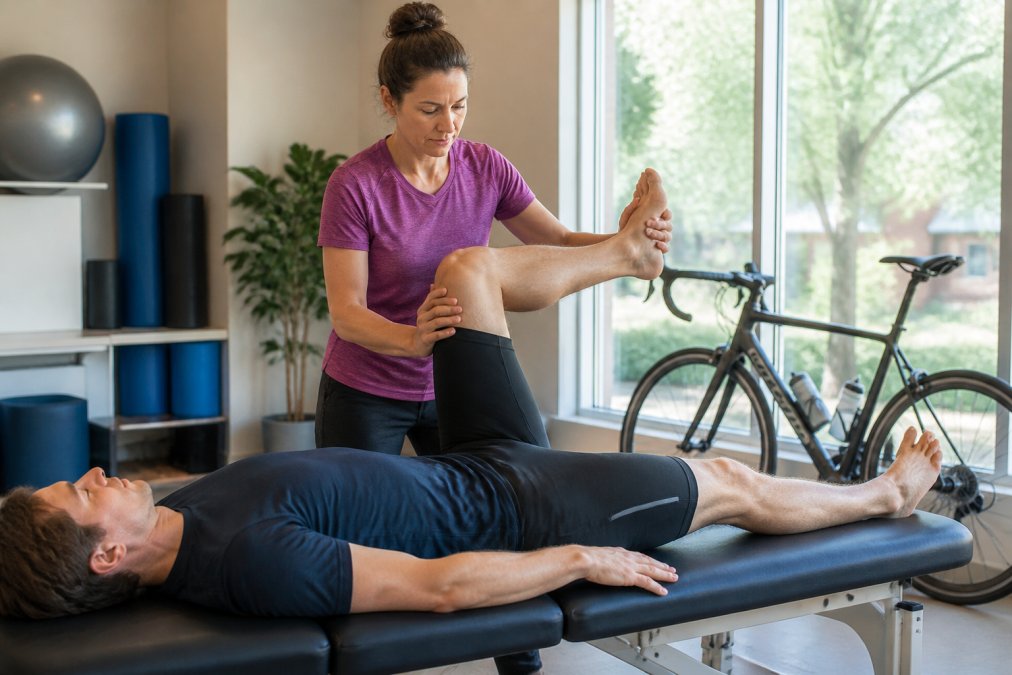
Bike fit and physical therapy solve different halves of the same problem. A fit changes the demands; physical therapy changes the body’s capacity to meet them. A fitter can raise a saddle, adjust cleat rotation, and shorten reach, but if a rider’s hip can’t extend past a certain point, no saddle height makes the position comfortable, and if the deep hip rotators can’t control knee tracking, no cleat adjustment stops the patella from irritating.
Bring your bike and your shoes to your first appointment. Seeing cleat wear patterns, saddle position, and handlebar drop tells us more in five minutes than an hour of description. Riders who bring their setup get to a working plan faster.
Cycling Injury Prevention Exercises That Address Root Causes
The best injury prevention program for cyclists targets the positions the bike doesn’t train. Cycling builds quadriceps and cardiovascular fitness, not hip extension strength, glute medius control, or thoracic extension. That asymmetry drives most overuse injuries: the tissues that stabilize the pelvis and control knee tracking are undertrained relative to those that produce power.
Why the Pedal Stroke Creates Predictable Weak Points
A pedal stroke is a closed-chain, sagittal-plane movement repeated thousands of times per ride. Three things follow:
- Hip extension happens under load, not through range. The glute max extends the hip from roughly 30-40 degrees of flexion back toward neutral, a short arc repeated at high frequency. Riders lacking end-range hip extension strength compensate with lumbar extension and hamstring dominance.
- Knee tracking is controlled proximally. Hip abductor and external rotator strength determine whether the femur rotates internally under load, which determines patellofemoral contact stress.
- The thoracic spine is held in flexion for the entire ride. Without extension and rotation work, the cost is reduced rib cage mobility, altered breathing mechanics, and increased cervical and lumbar load.
Off-Bike Strength and Mobility Work
A practical weekly routine covers four categories. Two sessions per week is enough for most riders; three during base season. The key is loading the patterns cycling misses.
- Hip extension strength: split squats, hip thrusts, and single-leg deadlifts to build the glute capacity cycling never demands. Load heavy enough to drive adaptation, bodyweight alone rarely changes tissue capacity in trained riders.
- Core stability: dead bugs, side planks, and Pallof presses to hold pelvic position under fatigue. Anti-rotation and anti-extension work transfers directly to posture on a moving platform.
- Thoracic mobility: open books and thoracic extensions to restore what hours in a flexed position take away.
- Soft tissue work: targeted work on quadriceps, hip flexors, and gluteal trigger points to restore tissue glide.
A Sample Two-Day Weekly Template
A common pattern for riders training 8-12 hours per week:
Day 1 (heavy, lower body focus)
- Split squat: 3 sets of 6-8 per leg, loaded
- Single-leg Romanian deadlift: 3 sets of 8 per leg
- Pallof press: 3 sets of 10 per side
- Side plank: 3 sets of 30-45 seconds per side
Day 2 (lighter, mobility and control focus)
- Hip thrust: 3 sets of 10
- Dead bug: 3 sets of 8 per side
- Open book: 2 sets of 8 per side
- Thoracic extension over a foam roller: 2 minutes
- Calf and hamstring soft tissue work: 5-10 minutes
Progression Rules That Prevent the Program From Backfiring
Adding load too quickly is its own injury mechanism. Three rules keep progression safe:
-
Increase load before volume. Add weight to a movement you already own before adding sets or reps.
-
Change one variable at a time. New exercise, new load, and new volume in the same week removes your ability to identify what caused a flare.
-
Deload every fourth week. Reduce volume by roughly a third during heavy training blocks. Tendons adapt more slowly than muscle, and the deload is where that adaptation catches up.
-
At least one hip extension exercise loaded above body weight
-
Anti-rotation core work, not just crunches
-
Thoracic extension and rotation, at least twice weekly
-
Single-leg balance or control work
-
Calf and hamstring soft tissue work
-
One full rest day per week during build phases
The goal isn’t a longer routine, it’s a routine that loads the three patterns cycling never challenges: hip extension under load, proximal knee control, and thoracic extension. Two well-programmed sessions per week beat five random ones.
Indoor vs. Outdoor Biomechanics: What Changes on the Trainer
Indoor and outdoor riding are not the same physical task, and treating them as interchangeable is a common source of winter injuries. Outdoors, the bike moves under the rider, it sways, rocks, and shifts with each pedal stroke, distributing load and letting the pelvis rotate slightly. On a fixed trainer, the bike doesn’t move, so the rider’s body absorbs everything the frame used to.
Three adjustments help:
- Use a rocker plate or trainer motion system to restore some lateral movement
- Stand and shift position every 10 minutes, even briefly
- Reduce continuous time in the saddle and build it gradually
Age-Specific and Equipment-Specific Considerations for Cyclists
Most cycling injury content treats every rider as a 30-year-old on a correctly fitted road bike. Two variables change the injury picture more than most riders expect: age and equipment.
Masters Cyclists: What Changes After 40
Masters riders make up a large share of the serious cycling population, and their physiology diverges from younger riders in ways that affect injury risk and recovery.
- Connective tissue adapts more slowly than muscle. Tendons and fascia respond to load on a longer timeline. A rider who can add 10% training volume per week at 30 may need two to three weeks for the same increase at 55 to avoid tendinopathy.
- Type II muscle fiber loss accelerates. Power declines faster than endurance, so the same climb or sprint demands a higher percentage of available strength. Riders compensate with cadence and gearing, but the hip and knee still absorb the load.
- Recovery capacity drops before fitness does. The ambition to train stays constant while the ability to absorb training falls, that mismatch produces most masters-level overuse injuries.
- Joint cartilage and meniscal changes accumulate. Degenerative changes on imaging don’t automatically cause pain, but they reduce the margin for poor tracking and high compressive load.
Equipment-Specific Injury Correlation
Gear changes are one of the most underused diagnostic clues in cycling. When pain develops within a few weeks of a new bike, new cleats, or a new saddle, investigate the equipment change first, before assuming the problem is the body.
How to Use This in Your Own Assessment
Keep a simple log of gear changes alongside your training log. When pain appears, being able to see that you changed saddles three weeks ago or swapped to shorter cranks two months ago turns a vague problem into a specific hypothesis you can test.
This is why a clinical assessment and a bike fit belong in the same process: the assessment identifies the limitation, the fit and equipment review identify the demand.
Recovery Protocols and Mental Health After a Cycling Injury
Recovery is where most riders underperform, and where the mental side of injury gets ignored.
Physical recovery protocols for cyclists include:
- Post-ride recovery: 10-15 minutes of easy spinning, hydration, and protein within the first hour
- Sleep: the single most effective recovery tool, and the first thing riders sacrifice
- Load management: increasing training volume gradually rather than in jumps
- Soft tissue mobilization: regular work on the tissues that tighten with cycling
- Active recovery: easy movement on off days rather than complete rest
What to Expect at Neuromuscular Strategies
We start with a clinical assessment, not a template: a full history, a movement screening, and a look at how you actually ride, including your position and equipment. From there we build a plan around your stability and mobility patterns.
Frequently Asked Questions
What are the most common cycling injuries treated by physical therapists?
Knee pain, particularly patellofemoral issues, tops the list, followed by low back pain, hip tightness, neck strain, and saddle sores. Overuse injuries from repetitive pedal stroke patterns are the norm. Achilles tendinopathy and plantar fasciitis also show up frequently. A clinical assessment can identify whether your pain comes from joint alignment, muscle imbalances, or training load errors. Physical therapy for cyclists in Boulder often starts with a full biomechanics review to pinpoint the driver.
How does a physical therapist assess a cyclist’s bike fit?
A physical therapist evaluates joint angles, pedal stroke symmetry, and how your body compensates under load. They watch you ride, check knee tracking, hip rock, and foot position. Unlike a fitting at a bike shop, this assessment also includes functional movement screening to see if hip tightness or core stability limits your position. The goal is to match the bike to your body, not force your body to fit the bike. Bike fit and physical therapy together address both the machine and the rider.
Can physical therapy help with chronic knee pain from cycling?
Yes. Chronic knee pain often stems from patellar tracking issues, weak glutes, or poor cleat alignment. A therapist will assess your pedal stroke, hip stability, and quad-to-hamstring balance. Treatment may include soft tissue mobilization, therapeutic exercise, and neuromuscular re-education. For cyclists in Boulder dealing with year-round knee pain, a structured program can reduce symptoms and restore power. Recovery timelines vary, but many riders see improvement within four to six weeks of consistent work.
Do I need a doctor’s referral for physical therapy in Colorado?
Colorado allows direct access to physical therapy, so you can see a PT without a physician referral in most cases. However, some insurance plans require a referral for coverage, and Medicare has specific rules. It is best to check with your insurer before booking. At Neuromuscular Strategies, the team can help clarify benefits and whether a referral is needed. Same-day or next-day appointments are often available, so you do not have to wait weeks to start.